Read Time:1 Minute
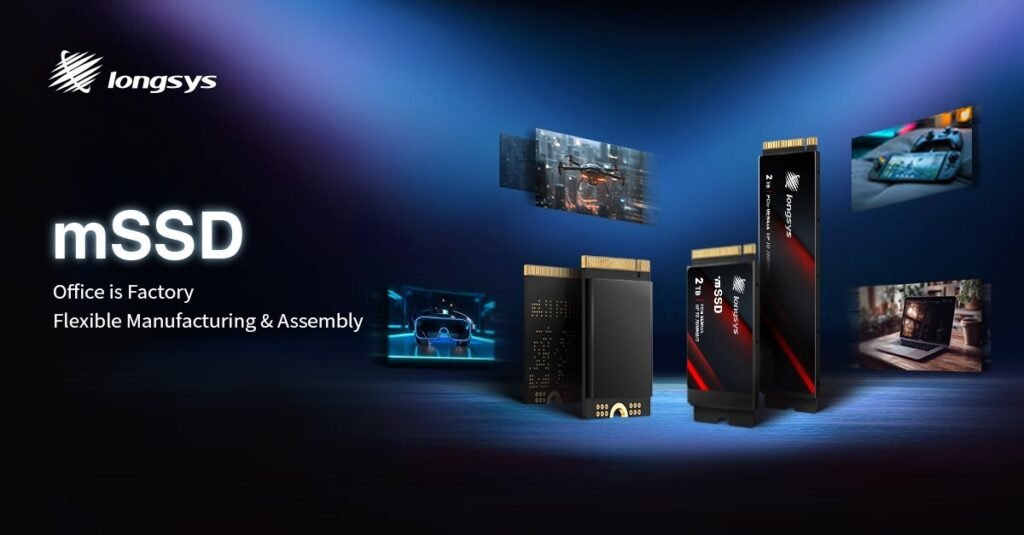
Longsys today launched the industry’s first integrated-packaging micro SSD (mSSD) in Shenzhen, China, claiming the design enables more flexible, efficient, and sustainable manufacturing by combining controller, NAND, and power modules into a single SiP package under its “Office is Factory” model.
The new mSSD eliminates nearly 1,000 solder joints found in traditional PCBA SSDs, which often lead to reliability issues such as heat degradation, solder contamination, and component interference. Longsys says the defect rate drops from ≤1,000 DPPM to ≤100 DPPM with this integrated approach.
By consolidating manufacturing steps — skipping PCB mounting, reflow soldering, and multiple transfers — Longsys claims it doubles delivery efficiency and cuts cost overhead by more than 10%, while also reducing energy usage and carbon emissions.
Despite its ultra-compact size (20 × 30 × 2.0 mm, 2.2 g), the mSSD meets PCIe Gen4×4 standards, delivering up to 7,400 MB/s read and 6,500 MB/s write speeds. It offers support for TLC and QLC NAND and spans capacities from 512 GB to 4 TB.
A standout feature is a clip-on thermal expansion module that allows the base mSSD to convert to different M.2 form factors (2230, 2242, 2280) without tools. This contributes to SKU consolidation and easier logistics for hardware partners. Longsys also enables on-site customization via UV or inkjet printing, aligning with its “Office is Factory” vision.
This innovation could reshape SSD manufacturing for devices where space, power, and reliability are critical — such as AI PCs, handheld gaming consoles, drones, and VR/AR systems. If Longsys can scale this model, it may set a new benchmark in how storage hardware is produced.
The new mSSD eliminates nearly 1,000 solder joints found in traditional PCBA SSDs, which often lead to reliability issues such as heat degradation, solder contamination, and component interference. Longsys says the defect rate drops from ≤1,000 DPPM to ≤100 DPPM with this integrated approach.
By consolidating manufacturing steps — skipping PCB mounting, reflow soldering, and multiple transfers — Longsys claims it doubles delivery efficiency and cuts cost overhead by more than 10%, while also reducing energy usage and carbon emissions.
Despite its ultra-compact size (20 × 30 × 2.0 mm, 2.2 g), the mSSD meets PCIe Gen4×4 standards, delivering up to 7,400 MB/s read and 6,500 MB/s write speeds. It offers support for TLC and QLC NAND and spans capacities from 512 GB to 4 TB.
A standout feature is a clip-on thermal expansion module that allows the base mSSD to convert to different M.2 form factors (2230, 2242, 2280) without tools. This contributes to SKU consolidation and easier logistics for hardware partners. Longsys also enables on-site customization via UV or inkjet printing, aligning with its “Office is Factory” vision.
This innovation could reshape SSD manufacturing for devices where space, power, and reliability are critical — such as AI PCs, handheld gaming consoles, drones, and VR/AR systems. If Longsys can scale this model, it may set a new benchmark in how storage hardware is produced.